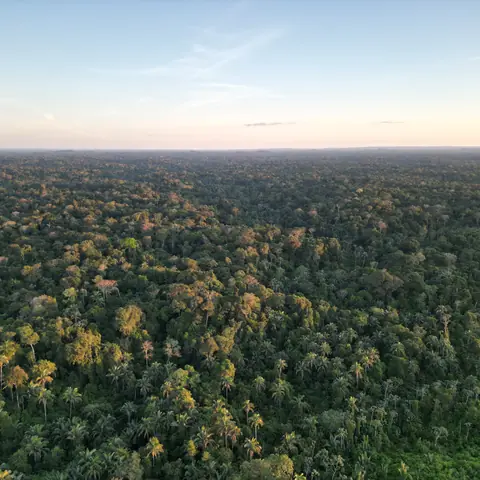
Phase 1 (BOLT): the project and the setting
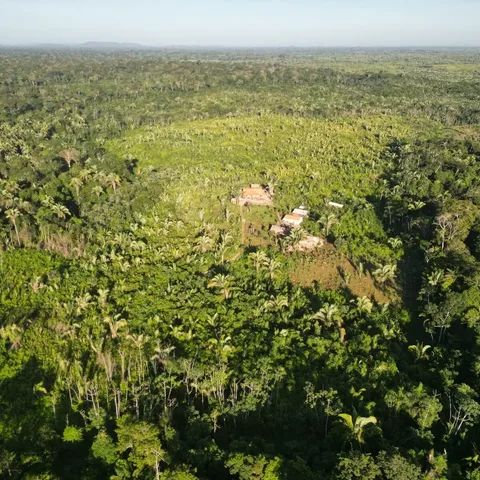
In the Terra Indígena Caru, an Indigenous territory in the state of Maranhão, the Forest Guardians, Indigenous teams who monitor and protect the territory, keep support bases at strategic points in the forest. These bases are used from time to time. It is precisely there that a connection is most needed in an emergency. Between these bases, the village and the nearest city lie kilometers of forest. In 2024, TECER (Tecnologias para Conexão Remota, or Technologies for Remote Connection), a project of Instituto Nupef, began to investigate whether an internet signal could cross that distance.
January 15, 2024
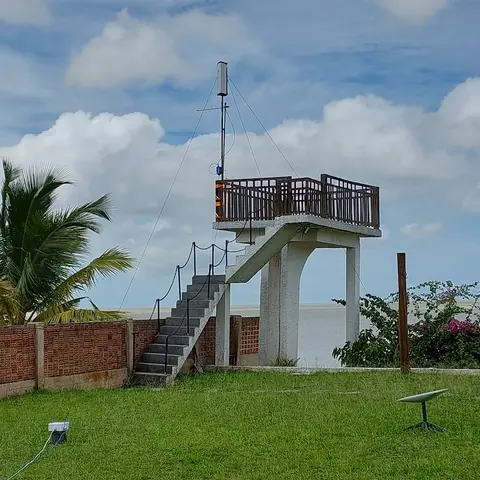
Phase 1: Mosqueiro, the first attempt
On a test bench, with the equipment a few meters apart, the signal arrived at 80% quality. Between January and February 2024, Nupef’s technical team took the same kit to Mosqueiro, a district of Belém, in the state of Pará. There the result was different: from 400 meters on, the equipment stopped communicating. Mosqueiro is a river island near Belém, surrounded by water and with a lot of vegetation. It offered three conditions the project would need to deal with in the Terra Indígena Caru, an Indigenous territory in the state of Maranhão: water, forest and distance. It was the right place to test the whole kit working together before taking it to a territory where any mistake would cost another long trip.
February 15, 2024
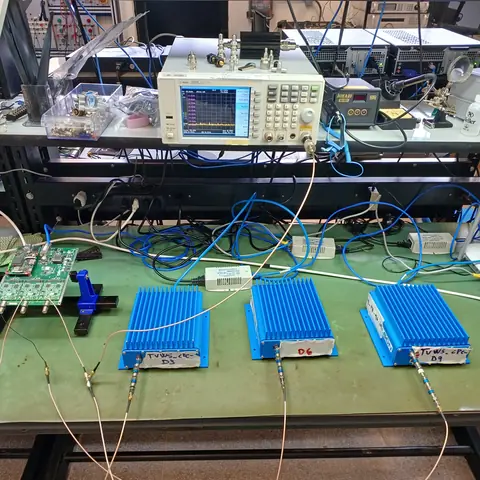
Phase 1: testing the hypotheses at UFPA and LASSE
When water comes out weakly from the tap at home, the cause could be in several places: in the water tank, in a clogged pipe, in a badly made joint. Looking only at the tap, there is no way to know. Nupef’s technical team was in a similar situation at the start of 2024. In the Mosqueiro test, the TVWS signal did not go beyond 400 meters and there were six possible explanations. To find out which of them were true, the team had to go back to the laboratory and examine each part of the signal’s path separately.
March 20, 2024
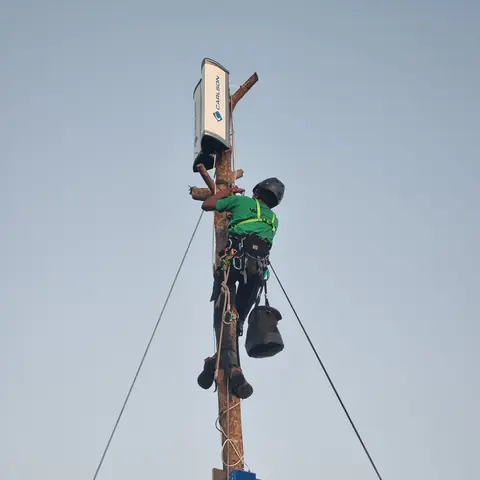
Phase 1: field deployment in Tururi
A piece of equipment can pass every laboratory test and still fail in the place it was designed for. In May 2024, after a test bench, a field test in Mosqueiro and a laboratory at the Federal University of Pará, the TECER project’s TVWS kit arrived at the Tururi village, in the Terra Indígena Caru, an Indigenous territory in the state of Maranhão. One question remained, the one that had mattered from the start: does the equipment work where it needs to work?
May 10, 2024
Phase 2: what Phase 1 taught us and the new proposal
Every long journey has a stop to look at the map. In 2024, TECER’s Phase 1 took a TVWS kit from the lab bench to the forest of Maranhão. In 2025, before starting Phase 2, the Instituto Nupef team stopped to look at the road travelled: what worked, what did not, and what had to change. That review gave rise to the new proposal, with a new territory, a new generation of equipment and a second network layer.
July 1, 2025